
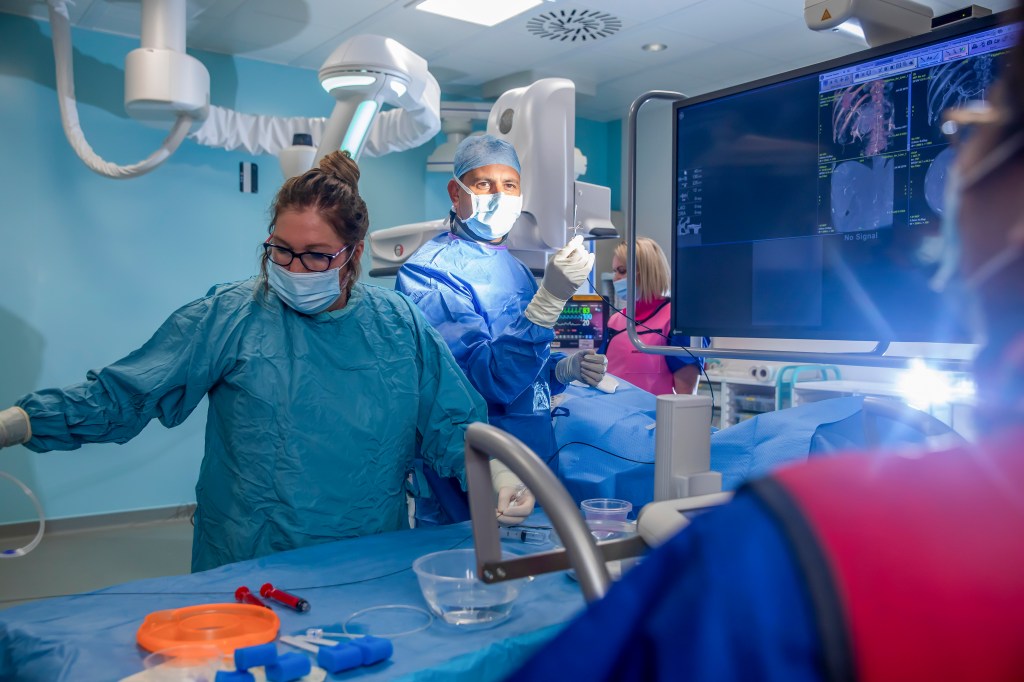
VASCULAR INTERVENTION (ARTERIAL)
In all arterial procedures we place a needle into an artery, usually in the groin but sometimes in the arm to gain access to the labyrinth of vessels to get anywhere in the body we need to get to the target for treatment. We use a variety of catheters and wires with various angles and tensions to allow us to guide around corners and access any vessel we want from those which supply the liver or kidneys, right down to the big toe! Most procedures can be done under local anaesthetic or sedation which allows quick recovery.
ANGIOPLASTY/STENTING
Arteries can become narrowed or clogged often due to smoking or a fatty diet, but also due to diabetes and other conditions. Angioplasty involves inserting tiny balloons into narrowed or blocked arteries to re-establish flow, most commonly in the leg arteries. The balloons can be inflated, then deflated, widening the vessel and allowing more blood flow. Metal stents can also be placed in certain types of disease, which reduce the chance of a rebuild up of material. Patients for angioplasty are usually referred to us by our vascular surgery colleagues and may prevent a surgical bypass operation. The procedure is usually performed under local anaesthetic and can often be done as a day case procedure.

ACUTE ARTERIAL CATHETER DIRECTED THROMBOLYSIS
This involves passing a tube into a blocked blood vessel and slowly injecting clot busting medication to try to unblock the vessel and re-establish blood flow. If blood flow cannot be re-established as quickly as possible, there is a real risk of limb loss. Patients for thrombolysis are usually referred to us by our vascular surgery colleagues and may prevent an open surgical declotting or bypass operation. Patients are admitted to the specialist vascular Enhanced Care Unit or General Critical Care for this procedure for close monitoring.

UTERINE ARTERY EMBOLISATION – FOR UTERINE FIBROIDS
Many women suffer with painful, heavy periods caused by uterine fibroids. This procedure involves inserting a needle into the groin, then passing a catheter into the uterine arteries under x-ray guidance. Once we’re in the right place, we inject tiny beads into the arteries which supply the uterus which flow into the fibroids and “clog” them up. This causes the fibroids to shrink as they can no longer obtain nutrients from the blood. Patients for uterine artery embolisation are referred to us by our gynaecology colleagues and may prevent a surgical operation such as myomectomy or hysterectomy. Patients are seen in an IR outpatient clinic prior to the procedure to ensure they understand the procedure and give informed consent. The procedure is performed under local anaesthetic and sedation, and requires an overnight stay on the gynaecology ward for observation and nursing care.

PROSTATE ARTERY EMBOLISATION – FOR BENIGN PROSTATIC HYPERTROPHY (BPH)
Many men suffer with difficulty passing urine due to an enlarged prostate. This procedure involves inserting a needle into the groin, then passing a catheter into the prostate arteries under x-ray guidance. Once we’re in the right place, we inject tiny beads into the arteries supplying the prostate which causes it to shrink and improves symptoms. Patients for prostate artery embolisation are referred to us by our urology colleagues and may prevent a surgical operation. Patients are seen in an IR outpatient clinic prior to the procedure to ensure they understand the procedure and give informed consent. The procedure is performed under local anaesthetic and sedation, and can often be performed as a day case procedure without the need for an overnight stay in hospital.

EMBOLISATION FOR POST-PARTUM BLEEDING
Following childbirth sometimes the uterus fails to contract enough to stop bleeding. There are many ways the bleeding can be stopped by the obstetric doctors but very rarely the bleeding doesn’t stop. In this scenario we can insert a needle into the artery in the groin and pass a catheter into the arteries supplying the uterus. We then inflate tiny balloons which stop the blood flow to the uterus. If this does not work, we can inject particles or a glue-like substance into the uterus to stop it from bleeding. We sometimes also perform this procedure in women who have complex problems with their placenta which puts them at high risk of bleeding during delivery. In those circumstances we insert balloons into the arteries, then inflate them as the baby is being delivered by c-section. This reduces the blood loss during c-section and helps the obstetric team deliver the placenta.

EMBOLISATION FOR GASTROINTESTINAL BLEEDING
Bleeding into the bowel is commonly controlled by putting a camera through the mouth or up the back passage to find the source and either inject it with glue or place metal clips on the bleeding vessel. Sometimes this fails so we are called to insert a needle into the artery in the groin, direct a catheter under x-ray guidance into the artery which supplies the bowel, then guide the catheter to the source of bleeding and stop it from the inside by using tiny metal coils, particles or glue. The black splodge on the below images shows the source of bleeding which is subsequently stopped. Patients for this procedure are usually referred by our gastroenterology colleagues and can be very sick. Although the procedure can be performed just under local anaesthetic, we often ask our anaesthetic colleagues to attend in case we need help when patients are bleeding profusely. Patients normally go back to the gastroenterology ward or ITU following this procedure for close observation and monitoring.

EMBOLISATION FOR TRAUMA
This involves identifying the source of internal bleeding in patients following trauma and using a variety of materials to stop the bleeding, including glue, beads, metallic coils and covered stents. More often than not, internal bleeding can be stopped without the need for a traditional open operation, thus avoiding the need for open surgery and an associated long recovery. The images below show bleeding into the spleen (black splodge) followed by stopping the bleeding with a single metal coil and disappearance of the black splodge. Although the procedure can be performed just under local anaesthetic, we often ask our anaesthetic colleagues to attend in case we need help when patients are bleeding profusely. Patients always go back to a ward or ITU following this procedure for close observation and monitoring.
.JPG)
VASCULAR INTERVENTION (VENOUS)
In all venous procedures we place a needle into a vein, usually in the groin or neck to gain access to the labyrinth of vessels to get anywhere in the body we need to get to the target for treatment. We use a variety of catheters and wires with various angles and tensions to allow us to guide around corners and access any vessel we want. Most procedures can be done under local anaesthetic or sedation which allows quick recovery.
VARICOCOELE EMBOLISATION
Some men suffer with distended veins in the scrotum which causes swelling and pain. This procedure involves inserting a needle into the vein in the groin or neck, then guiding a catheter under x-ray guidance to the vein draining the scrotum. We then place metal coils or glue into the vein draining the scrotum which relieves the symptoms. We now also perform this procedure for some men with poor sperm function as there is an association with subfertility. Patients for this procedure are referred to us by our urology colleagues or the subfertility clinic. Patients are seen in an IR outpatient clinic prior to the procedure to ensure they understand the procedure and give informed consent. The below x-ray images show a catheter inside the veins and following deployment of coils in the testicular vein. This procedure is performed under local anaesthetic as a day case procedure which allows a very quick recovery.

LONG TERM VENOUS ACCESS
Some patients need regular intravenous therapy such as chemotherapy or antibiotics or may require a line for dialysis. We insert a needle into a vein and guide a tube over a wire. We then bury the tube under the skin to prevent infection. They are often inserted into the veins in the neck and chest, but can be inserted into the veins in the groin. They are sometimes referred to as Hickman lines, Bard lines, dialysis lines or tunneled central lines. This procedure is usually performed under local anaesthetic and sometimes with sedation. Most are performed as a day case procedure which allows for a quick recovery.

ARTERIO-VENOUS FISTULOPLASTY
Some patients have a surgically formed connection between an artery and vein in the arm to have dialysis if their kidneys have failed. Sometimes these fistulas develop a narrowing. We insert tiny balloons to open up the narrowings to keep the fistula working. The images below show a balloon being inflated in a narrowed segment in the upper arm, then the narrowing is gone. This procedure is performed under local anaesthetic as a day case procedure which allows a very quick recovery.

THROMBOLYSIS
Some patients can develop a clot in an artery or a vein. We insert tubes to the affect vessel and slowly drip clot busting drug directly into the affected vessel to dissolve the clot and re-establish blood flow to the affected area. Patients for thrombolysis are usually referred to us by our vascular surgery colleagues and may prevent an open surgical declotting operation. Patients are admitted to the specialist vascular Enhanced Care Unit or General Critical Care for this procedure for close monitoring.

THROMBECTOMY
Sometimes when clot forms in an artery or a vein we can insert a tube and either suck out the clot using a vacuum or macerate the clot to break it up to help re-establish flow to the affected area. We often perform this procedure on fistulas which have clotted off but it can be performed in other vessels.

TRANSJUGULAR INTRAHEPATIC PORTOSYSTEMIC SHUNT (TIPS)
Patients with liver disease can develop dilated veins in the abdomen and around the oesophagus due to high pressure within these veins. These can rupture and lead to life-threatening bleeding. To prevent this, we insert a needle into a vein in the neck and guide a wire into the liver. We then form a communication between the liver and the heart to reduce the pressure in the veins and prevent the chance of catastrophic bleeding. The x-ray images below show how this is performed. Patients for this procedure are referred to us by our gastroenterology colleagues. This is a complex and challenging procedure and is one of very few procedures we perform under general anaesthesia. Patients are cared for on the gastroenterology ward after their procedure for close observation and monitoring.

INFERIOR VENA CAVA (IVC) FILTERS
In patients with DVT (clot in the legs) it’s sometimes necessary to put a filter in the main vein going back to the heart to prevent clot travelling to the lungs, which can be life-threatening. We insert these filters through the vein in the groin or the neck and remove them once the clot in the leg has dissolved. Removing the filter is like playing a game of “hook a duck” where we have to put a loop around a tiny 2mm hook inside the centre of the body, all performed from the neck whilst looking inside you with an x-ray camera. Patients for this procedure are referred to us by our medical and surgical colleagues. This procedure is performed under local anaesthetic and can be done as a day case procedure which allows for a quick recovery.

NON-VASCULAR INTERVENTION
This is a vast area of IR and includes a huge variety of procedures. Fundamentally many procedures share the same steps in that we use ultrasound, CT or x-ray to insert a needle into a particular organ (liver, kidney, stomach, spine etc) then we insert a wire and catheter into that organ, then perform whatever procedure we need to.
NEPHROSTOMY & URETERIC STENT
If the kidney becomes blocked by stones or tumours we insert a needle through the skin into the kidney using ultrasound to guide us. Once inside the kidney we use x-rays to guide a wire down to the bladder and insert a stent between the kidney and bladder to bypass the blockage. Patients for this procedure are usually referred to us by our urology or oncology colleagues. It is often performed using local anaesthetic or sometimes with sedation in challenging cases. Patients are cared for on a ward following the procedure for close observation and monitoring.

PERCUTANEOUS TRANSHEPATIC CHOLANGIOGRAM (PTC)
If the liver becomes blocked by stones or tumours we insert a needle through the skin into a tiny duct in the liver using ultrasound to guide us. Once inside we use x-rays to guide a wire through the liver into the bowel and insert a stent between the liver and bowel to bypass the blockage. Patients for this procedure are usually referred to us by our gastroenterology, oncology or hepatobiliary colleagues. It is performed under local anaesthetic and sedation as it can be a challenging procedure. Patients are cared for on a ward following the procedure for close observation and monitoring.

RADIOLOGICALLY INSERTED GASTROSTOMY (RIG)
If a patient is unable to eat and drink normally (normally due to a stroke or cancer) we insert a needle through the skin directly into the stomach using x-ray guidance and pass a feeding tube through the skin into the stomach using the wire as a guide. Patients for this procedure are usually referred to us by the nutrition team after careful assessment. It is performed under local anaesthetic and sedation as it can be a challenging procedure. Patients are cared for on a ward following the procedure for close observation and monitoring.

VERTEBROPLASTY
In certain types of spinal fractures or where there is collapse of vertebrae due to cancer, we can insert a needle through the skin and into the spine using x-ray guidance and inject cement into the spine to help stabilise it and prevent further fracture. Patients for this procedure are usually referred to us by our orthopaedic, oncology or neurosurgical colleagues. Patients are usually seen in an IR outpatient clinic prior to the procedure to ensure they understand the procedure and give informed consent. The procedure is performed under local anaesthetic and sedation as it can be a challenging procedure. Patients are cared for on a ward following the procedure for close observation and monitoring.

IMAGE GUIDED BIOPSIES
Using ultrasound or CT guidance we can insert a needle to nearly anywhere in the body and obtain a sample of tissue to assess whether there is infection or tumour or other types of disease present at this location. The image below shows a CT image of a needle being inserted into a lung cancer. Patients for this procedure can be referred to us by any medical or surgical specialty. It is usually performed under local anaesthetic. Some procedures can be performed as day case procedures but often patients are cared for on a ward following the procedure for close observation and monitoring.

IMAGE GUIDED DRAINS
Using ultrasound or CT guidance we can insert a needle into fluid collections or abscesses anywhere in the body and insert a drain over a wire to remove the fluid or abscess. The CT images below show a drain being inserted into an abscess in the pelvis. Patients for this procedure can be referred to us by any medical or surgical specialty. It is usually performed under local anaesthetic. Most patients requiring abscess drainage are quite poorly and need post procedure care on a ward for close observation and monitoring.

CHOLECYSTOSTOMY
If the gall bladder becomes blocked with stones or tumour it can make patients very unwell and lead to septicaemia. We use ultrasound or CT to guide a needle through the skin and liver into the gall bladder. We then insert a tube over a wire to allow the gall bladder to drain. This procedure is usually performed under local anaesthetic. Most patients requiring cholecystostomy are quite poorly and need post procedure care on a ward or ITU for close observation and monitoring.

CHOLECYSTO-DUODENAL STENTING (A.K.A GUPTAS PROCEDURE)
If someone suffers with gallstones, they usually have their gall bladder removed surgically. If they are not fit for surgery, they may be left with a drain in their gall bladder (cholecystostomy) for the rest of their life to prevent gall bladder infections. For these patients it’s sometimes possible to place a drain between the gall bladder and the bowel to reduce the risk of further blockages. This is locally known as a GUPTAS procedure (Gallbladder drain internalisation Using a Percutaneous Trans-Amullary Stent) as Dr Gupta is usually the IR Consultant who performs this specialised procedure. Patients for this procedure are referred by our specialist hepatobiliary colleagues following careful assessment and Dr Gupta often sees them in his outpatient clinic to discuss the procedure. It is performed under local anaesthetic and sedation and can sometimes be performed as a day case procedure to allow quick recovery.

INTERVENTIONAL ONCOLOGY
There are a variety of minimally invasive image guided techniques we now use to treat cancer or to aid in the treatment of cancer.
PERCUTANEOUS TUMOUR ABLATION
Here we place a needle through the skin directly into a tumour using ultrasound or CT to show us where to go. We then deliver extreme heat or cold down the needle to burn the tumour from the inside. We usually treat tumours in the liver, lung or kidney but are advancing to treat tumours in the pancreas and elsewhere in the body. Patients are referred to us by our medical and surgical colleagues. Ablation is usually performed under general anaesthesia but can often be done as a day case procedure to allow quick recovery.

PORTAL VEIN EMBOLISATION (PVE)
Here we insert a needle through the skin under ultrasound guidance directly into the main vessel which supplies the liver with blood. We then inject glue, beads or tiny metal coils to block off the blood supply to the side of the liver which contains tumour. This causes this side of the liver to shrink and the opposite side to grow which allows surgeons to remove the cancerous side of the liver without putting the patient into liver failure. Patients for this procedure are referred to us by our hepatobiliary surgical colleagues. The procedure can be performed under local anaesthetic but often we keep patients overnight on a ward for close observation and monitoring.

PRE-OPERATIVE TUMOUR EMBOLISATION
If a tumour is very large or has an extensive blood supply, we can insert a needle into an artery (usually in the groin) and pass a tiny tube (catheter) up through the aorta and into the artery that supplies the tumour with blood. We can then inject glue or tiny beads, particles or tiny metal coils into the arteries supplying the tumour which blocks the blood supply. Due to a lack of blood the tumour shrinks and has less blood in it, making it easier to remove by traditional open surgery. Patients for this procedure are referred to us by various surgical specialties and can be performed under local anaesthetic. Patients usually stay overnight on a ward after the procedure for close observation and monitoring.

TRANS-ARTERIAL CHEMO-EMBOLISATION (TACE)
This uses the same technique as tumour embolisation but once we get to the artery supplying the tumour we inject tiny plastic beads coated in chemotherapy. The beads get “stuck” in the tumour and slowly deliver chemotherapy directly into the tumour. This reduces the numerous side effects from traditional chemotherapy. Patients for this procedure are referred to us by our gastroenterology or oncology colleagues. The procedure is performed under local anaesthetic and sedation and patients stay overnight on the ward following the procedure for close observation and monitoring.

 Interventional Radiology Solutions Ltd